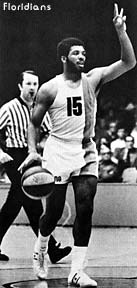

1968-1970 Miami Floridians LogoFloridians 1970-71 LogoFloridians 1971-72 Logo

Miami Floridians/The Floridians

Years of existence:
1968-69 through 1969-70 (Miami Floridians)
1970-71 through 1971-72 (The Floridians)
Colors:
1968-69 & 1969-70: Orange & Blue
1970-71 & 1971-72: Hot Orange & Magenta
Home Arenas:
Miami Beach Convention Hall (9,500)
Miami-Dade Junior College North (6,000)
Dinner Key Auditorium (6,900)
Curtis Hixon Hall (Tampa) (6,000)
Bayfront Arena (St. Petersburg) (7,500)
Jacksonville Coliseum (8,500)
Coaches:
1968-69: Jim Pollard
1969-70: Jim Pollard & Harold Blitman
1970-71: Harold Blitman & Bob Bass
1971-72: Bob Bass
Floridians Fan Memories
Detailed Franchise Year-to-Year Notes
Floridians Ownership History and Rosters

Franchise All-Time Top 20 Scorers

Back to "Remember the ABA" Main Page

Did you see an ABA Floridians game? Or, did you have a favorite Floridians player? Contribute to this web page by describing your favorite ABA Floridians memories.

(portions from Jim Grasso and the December 1974 ABA Fan Club Newsletter -- used with permission)

The Floridians existed for only four ABA seasons (from 1968-69 through 1971-72). They moved to Miami from Minnesota (where they were the Muskies in 1967-68), and stayed in Florida until they folded in May 1972. Why were they called simply "The Floridians"? Because during the later years of their existence, the team played games all over Florida. Most games were in Miami, some were in Tampa/St. Pete and Jacksonville, and a small number were in West Palm Beach.
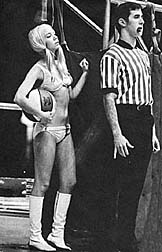
What do Floridians fans remember about their team? The Floridians were renowned for their scantily clad ballgirls and crazy promotions. Research for the 1997 HBO documentary on the ABA turned up some Floridians video footage. Predictably, almost all of the footage showed the ballgirls.

On October 31, 1970, the Floridians home program advertised the team's next two home games. It didn't even mention the two ABA teams the Floridians were going to play. Instead, the program stated: "FREE PANTYHOSE--The Floridians return to the Convention Hall Thursday, Nov. 5, for Ladies Night, with pantyhose given away to the first 500 ladies through the turnstiles. The pantyhose are a regular $2 value, honey in color and sheer, stretch nylon that fit any size of women five-feet to five-feet, nine inches tall. Nothing extra to buy, women don't even need reserved seats. There are also other special surprises for the ladies. But come early. The next home game is -- Tuesday Nov. 10 : a basketball-boxing doubleheader. Buy a $5 ticket which allows you to walk to the adjacent Auditorium to see heavyweight Jimmy Ellis' first fight since his loss to Joe Frazier. It's a unique basketball-boxing doubleheader! The Ellis fight doesn't begin until the game ends."

Other Floridians promotions included these creative giveaways: live turkeys for Thanksgiving, 15 pounds of smoked fish (to one lucky fan!), 57 pounds of Irish potatoes (on "Irish Night," also to one lucky fan), 53 pumpkin pies, vats of gefilte fish, kegs of beer, ice cream, and ABA balls.

The history of the Floridians began, curiously, in wintery Bloomington, Minnesota. During the ABA's inaugural season (1967-68), Larry Shields' Minnesota Muskies were a bust at the box office, despite a 50-28 record. Shields found the allure of glittering Miami irresistible and, getting a small group of Florida businessmen to buy shares of the franchise, moved it south. Before leaving Minnesota, Shields made what must be the worst deal in ABA history: the trade of Rookie-of-the-Year Mel Daniels to the Indiana Pacers for $100,000, a draft choice, and two warm bodies. Shields needed the money to pay his Minnesota debts. If he could have afforded to keep Daniels, the Floridian story may have had a more happy ending.

The Floridians' first homes were the Miami Beach Convention Center and the Convention Center Annex. For trivia buffs, the team colors were orange, blue and white. Jim Pollard coached the team to a strong second place finish in its first season (1968-69), with Skip Thoren taking over the pivot from Mel Daniels, and Donnie Freeman and Les (Big Game) Hunter providing the firepower. In the first round of the 1969 ABA Playoffs, Miami eliminated the Minnesota Pipers (the defending ABA Champions), four games to three. Game 7 of this series took place in Miami, where a rare large crowd helped the Floridians to a series-clinching victory over Connie Hawkins and the Pipers. However, the Pacers (led by Daniels) won the Eastern Division Finals over Miami four games to one.

Attendance, although better than in Minnesota, was still very poor. Part of the problem was that the Floridians played in Miami Beach while most of their potential fans lived on the mainland. Also, at the time, Miami was not exactly a "basketball hotbed" (despite the collegiate exploits of Rick Barry at the University of Miami).

The next year (1969-70), the Floridians' home areas were, believe it or not, an ex-aircraft hangar (Dinner Key Auditorium) and a junior college gym. The Florida investors, led by Dr. Thomas Carney, took over more of the direction of the franchise. Miami signed one of the NBA's #1 draft choices, Larry Cannon of LaSalle, and small college rebounding champ Wil Jones. In an effort to appeal to Miami's Cuban-Americans, the Floridians also signed rookie Al Cueto. Early in the season, center Skip Thoren ruined his knee -- ending a promising career. The Floridians' new coach, Hal Blitman, in converting Cannon into a guard, tried to bring him along slowly. But the temperamental rookie stormed out of the arena in the middle of a game because of a lack of playing time, threatening to jump the team. Blitman and Cannon eventually patched things up, but the team sputtered along. The direction of the franchise became extremely confused, with trades being made by the owners without Blitman's or the general manager's knowledge. The Floridians ended the 1969-70 season in last place. Donnie Freeman, one of the finest guards every to dribble the multicolored basketball, averaged 27.4 ppg -- tops on the team. For what likely was an ABA record, 22 different players wore the Miami orange, blue and white that season.
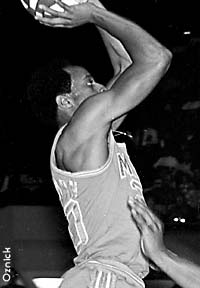
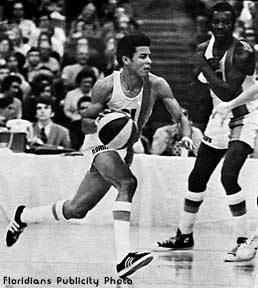
Donnie Freeman
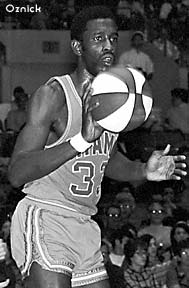
Don Sidle
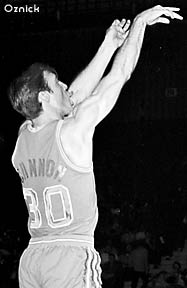
Larry Cannon
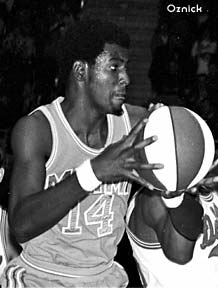
Wil Jones During the 1969-70 season, the Miami Floridians stumbled to incredible lows. During the two previous seasons, the franchise was among the best in the ABA. But in 1969-70, Miami had a 23-61 record, the worst in all of professional basketball. Amazingly, 22 (that's right, 22) different players wore a Floridians uniform that season.

Don Freeman (above left, #20) delivered despite the team's struggles, averaging an impressive 27.4 ppg. Don Sidle (above middle, #33) also managed to salvage a strong season, averaging 20.8 ppg.

Heralded rookie Larry Cannon (above right, #30) had a rough adjustment to the pros. He feuded with Miami Coach Hal Blitman and enjoyed better seasons later in his ABA career with the Denver Rockets and Indiana Pacers.

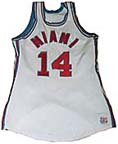
Another Miami rookie standout was 6-8 forward Wil Jones (#14, left). In his first year in the ABA, Jones was still learning how to score. From day one, though, he could rebound. In 1969-70 he scored only 8.2 ppg, but averaged a very strong 7.6 rebounds per contest. In the midst of Miami's 1969-70 mess no one could foresee that Jones would become one of the ABA's most rugged defenders. He played 6 more ABA seasons and eventually anchored the defense of the 1974-75 ABA Champion Kentucky Colonels. Following the merger in 1976, Jones played two additional seasons in the NBA (for the Pacers and the Buffalo Braves). Photos Copyright © John Oznick and used with permission.

The original Miami owners wanted out; they had lost a lot of money over two seasons. In stepped Ned Doyle, a retired advertising executive (best known in the ad world for his imaginative Volkswagen ads) to buy the team. Doyle, in effect, fired the team but kept the coach -- a rather novel approach. He also dropped "Miami" from the team name and the franchise went "regional," playing its home games in Miami Beach (back in the Convention Center), Jacksonville, Tampa/St. Pete and West Palm Beach. The team colors were changed to magenta, orange and black. Ball girls, wearing skimpy bikinis, were hired. General Manager Dennis Murphy, spending plenty of Doyle's money, acquired Mack Calvin, Larry Jones, Tom "Trooper" Washington, and Ron Franz.

During the 1970-71 season, Calvin was a first-team ABA All-Star selection and averaged 27.2 ppg. Alongside Calvin, Jones scored at a 24.3 ppg clip. According to the Floridians' media guide, these two created the highest scoring guard combination in the history of professional basketball. In December of 1970, the Floridians obtained 6'9" ABA veteran Ira Harge. Harge played some of the best basketball of his career down the stretch of the 1970-71 season, averaging 15.4 ppg and 14.1 rpg with the Floridians. Harge's presence took the pressure off of Calvin and Jones, and allowed the team to make a late season playoff drive. Bob Bass assumed the coaching reigns from Hal Blitman on January 15, 1971. At that time, the Floridians were stuck in last place in the Eastern Division. After Bass took over, the team won 19 of its final 36 games, including seven crucial contests in a row, to pass Carolina and Pittsburgh for a playoff berth. In the first round of the 1971 Playoffs, the frenetic offensive attack of Calvin and Jones confused a powerful Kentucky team, and the Floridians extended the eventual runner-up Colonels to a six game series.

Doyle was determined to give it one more try. For 1971-72, the "regional franchise" setup was largely dropped (34 of the team's home games were scheduled for Miami, and only 7 were scheduled for Tampa/St. Pete). Also, the Floridians acquired Warren Jabali and Manny Leaks for added firepower. Bass' team played scrappy ball, and the Floridians were fun to watch. In particular, Jabali had one of his very best pro seasons. He scored 19.9 points per game, dished out 6.2 assists per game, and grabbed 8.2 rebounds per game (playing an average of 40.2 minutes per contest). Jabali also hit 102 out of 285 three-pointers for an impressive .358 percentage (good for 3rd in the ABA behind Glen Combs of Utah and Louie Dampier of Kentucky). He made the East squad in the 1972 ABA All-Star Game and won about 10 games for the Floridians with heroic performances in closing minutes.

Calvin remained the team's high scorer, averaging 21 points per game and hitting 87% from the free throw line (2nd in the league behind Rick Barry). Jones also had a nice year, averaging 17.6 points per game, and finishing 5th in the entire league with a 53.1% two-point field goal percentage. Unfortunately, Jones suffered a broken hand in the middle of the season and missed 19 straight games. The Floridians went 4-15 during that stretch (in contrast to a 32-33 record WITH Jones in the lineup). Leaks left the team late in the season after a salary dispute, leaving the Floridians with a serious void on defense, especially in the middle. With their frenetic offensive attack offset by ineffective team defense, the Floridians limped to a 36-48 record -- good for fourth place in the Eastern Division and a playoff spot. In the first round of the ABA Playoffs, the Floridians bowed out in four straight to rookie phenom Julius Erving and the Virginia Squires. During the course of that series, Erving had three games of over thirty rebounds and completely overwhelmed the Floridians.
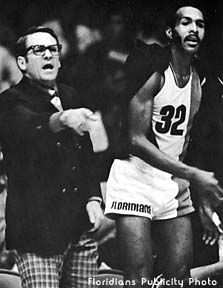
Bob Bass and Larry Jones Mack Calvin
Warren Jabali The 1971-72 Floridians were entertaining in a number of different ways. To say the least, the ballgirls were memorable, and the prize giveaways to fans were . . . unusual.

But, for those fans who actually showed up at the Miami Beach Convention Hall to cheer the team, the Floridians were a lot of fun to watch. Coach Bob Bass (above left) directed a relentless run-and-gun attack using the potent guard combination of Larry Jones (above left, #32) and Mack Calvin (above right).

While Jones was slowed by a broken hand that season, the Floridians also had Warren Jabali, another of the ABA's best guards. Jabali, acquired from the Pacers prior to the 71-72 season, had a great season. Jabali quarterbacked the Floridians to their third playoff appearance in four years. The only problem? Dr. J and the Virginia Squires, their first round playoff opponent. Erving and the Squires dispatched the Floridians in four quick games. Game 4, played at Miami Dade Community College (North Campus) turned out to be the last ever Floridians game.

In 1997, Jones, Calvin and Jabali were each named to the 30-man All-Time ABA Team.

Ballgirls and bikinis aside, the Floridians were unable to dent the indifference to pro basketball in south Florida. The two home playoff games against Virginia drew only 2,965 and 3,126 fans and even the perennially optimistic Doyle saw the futility of continuing. All that remained was for Doyle to disband the franchise. The players were dispersed to other ABA teams and the Floridians became a memory -- a nice try -- a monument to optimism and dogged persistence.
MEMORIES OF BILL GRONVOLD: "I used to be a board operator at WOCN in Miami. WOCN was the flagship radio station of the Miami Floridians in 1969. We never used to know whether games would actually air, as we didn't know if the line charges had been paid. I remember that I could go to Floridians games for a buck. The games were played at various sites around South Florida, including a former airplane hangar in Coconut Grove (Dinner Key Auditorium) and a community college gymnasium. I was at a game at the Dinner Key Auditorium one night when referee Norm Drucker jumped over the scorer's table and into the crowd to confront a fan who had thrown something onto the court following a close officiating call. Players and other fans had to restrain him."

MEMORIES OF LYNN SHACKELFORD (Miami Floridians player, 1969-70): "I suppose what I remember most is when I joined the Miami Floridians in January of 1970, I had come from 3 NCAA championships at UCLA. Our 3 year varsity record was 88-2. After I signed with the Floridians, we promptly lost 10 straight. Very quickly, I learned again how it felt to lose. Our coach, Hal Blitman, told me that he had studied John Wooden's record and that he, Blitman, was actually ahead of Wooden at a similar stage in his career. This of course was prior to the Floridians going down the tubes. It was like Grand Central Station that year, with all the players coming and going. I remember playing with Al Cueto, the world's tallest Cuban (where are you Al?). Actually I was only there a couple of months and then went to work for the owner (Bob Howard), who was struggling in the shopping center development business."

MEMORIES OF HOWARD LEIBOWITZ: "In the early 1970's I moved to South Florida and I went to several Floridians games. I have a few memories of the team. One was an advertising campaign they had for the 1970-71 season. It referred to the team's dismal season the year before. They said that instead of firing the coach and keeping the players, they fired all the players and kept the coach. The print ad had the coach (Hal Blitman) standing next to a group of players who were covered up by a big sheet. From the way they played before, they should have fired the players AND the coach. Blitman actually became my high school vice principal a couple of years after the team folded. In regards to the scantily clad ball girls, I happened to save a program from a Floridians game. Of course, it contained a picture of the ball girls. Several years later I started a new math class in high school. You guessed it, one of the ex-ball girls was now my math teacher. She was a little embarrassed (to say the least) when I brought the program in for the rest of the class to see."

MEMORIES OF STEVE JAFFE: "I used to go to the Floridians games in the Miami Beach Convention Center. I was at the Convention Hall quite often in those days because it also hosted World Championship Wrestling. The local champs were Dusty Rhodes and Jack Briscoe - and we would go to see them more frequently than the Floridians! I believe I had my 10th or 11th birthday party at a Floridians game. My buddies and I all sat in the second or third row and we spent most of our time looking at the ball girls. I went home with a red white and blue ball. The most amazing thing was that coach Hal Blitman suddenly ended up as the vice principal of my junior high school. Ironically, he did not coach our basketball team. But what a nice guy. I am sure that after a few years in the wild and woolly ABA, overseeing a bunch of kids looked like a great job. Finally, I remember a song that the Floridians put on the radio to advertise the games. It was called 'Get that ball, Floridians.' Catchy, no?"

MEMORIES OF JOHN J. LIFRIERI: "I grew up in South Florida in the 70's and at 10 years old I was a huge Floridians fan. I would listen to the games on AM radio and keep stats on my loose leaf school paper. Calvin 28 points, Jones 19 points, etc. I never missed a game. Back then the games were almost never televised so I had to visualize what the players looked like. An older friend caught wind of my fanatical behavior and told his best friend about me. Bill Zei was a young sports writer for the local Hollywood Sun-Tattler and covered the Floridians back in 71-72. Bill asked me if I wanted to go with him to a game and of course I was eager to go. With permission from my folks, we enjoyed the game. At half-time Bill lead me down to the press table where I met and actually was interviewed live by play-by-play announcer Sam Smith. After the Floridian win, I met Mack Calvin in the locker room. All was recorded in a special article in the Sun-Tattler (written by Bill), explaining the loyal fan I was. I believe it was titled 'Little Johnny at Floridians.' I will never forget the thrill and I still keep the paper article tucked away somewhere."

MEMORIES OF GLEN ORENSTEIN: "I can remember visiting my grandparents in Florida as a 9 year old. We went to see the Floridians play the Virginia Squires at the Miami Beach Convention Hall. My grandfather was a former New York City high school basketball coach and knew Larry Brown's family. He did not follow the ABA closely and thought that Brown was still with the Squires. After we arrived at the game, he was informed by a Squires player that Brown had been traded and was now a Denver Rocket. The Squire who told my grandfather this while he was warming up? Doug Moe. At that same game, at halftime, they let the kids go on the floor and shoot baskets until the teams came out for the second half. Now if they only let me do this at Madison Square Garden today. At the end of the game, I had my program autographed by a number of players including the Floridians' star player Mack Calvin, Larry Jones and a few Squires (including Doug Moe and current Detroit Piston head coach George Irvine). Still have it."

MEMORIES OF RANDY ILES: "I was one of only several hundred people who attended a Pittsburgh Condors at Floridians game in Miami. I was on spring break there. My fraternity brothers from Penn State dragged me to the game because they were all from Pittsburgh. As far as details, I can only remember the great ball girls."

MEMORIES OF STEVEN HERBERT: "I had the pleasure of attending five Floridians games at the Miami Beach Convention Center during the 1970-71 and 1971-72 seasons while visiting my paternal grandparents. They owned a hotel on Collins Avenue, only two blocks from the Convention Center. The only time I ever had a birthday party was at a New York Nets at Floridians game. I still have the red-white-and-blue ABA ball I received from the Floridians as a party gift 30 years ago.

The Floridians gave me so many wonderful memories, perhaps more than any other professional sports team. I thought their advertising slogan for the 1970-71 season was better than any other professional team I can remember. They were 23-61 the previous season, the worst record among all 25 professional basketball teams. Their advertising slogan was, 'We didn't fire the coach, we fired the team.' I remember the advertising copy acknowledging that the Floridians had professional basketball's worst record the previous season. It then declared that most teams would have fired the coach, but the Floridians did not. They fired the team. Every player from the previous season's team was traded, cut or retired.

To me, that was such an innovative approach. I wish another team would try that to see what would happen. The likeliest place would be the NBA, but salary cap considerations, and the probability that every team has at least one player it would want to keep, make that unlikely. The Floridians had such innovative ownership. Their owner the final two seasons was Ned Doyle of the famed New York City-based advertising agency, Doyle Dane Bernbach, best known for its Volkswagen, Avis ('We Try Harder') and Alka-Seltzer ('Mama mia, that's a spicy meatball') campaigns. Ned Doyle knew businesses like the Floridians had to be innovative to succeed and he made certain the Floridians would be as innovative as possible.

I also remember that for a game in Madison Square Garden on St. Patrick's Day, 1971, the Floridians decided to wear uniforms with O' preceding every player's name, so there was O'Jones, O'Calvin, O'Harge, etc. At the time, the Floridians actually had a guard named Fran O'Hanlon. There was a concern before the game that the MSG official scorer would just remove the O' from O'Hanlon's name and he would come out 'Hanlon' in the box score. I do not think that happened though."

MEMORIES OF BRIAN GADINSKY: "As a kid living in Miami Beach, I loved the Floridians. They played many of their games at the Miami Beach Convention Hall. Three great memories:

• When the team was owned by ad mogul Ned Doyle, the promotions were very creative. I once won a vat of gefilte fish in a ticket raffle. And it came with horseradish!

• Miami Dolphins kicker Garo Yepremian was on hand one day. He tried to kick a football from behind the stands into the basket.

• I'll never forget hanging out after the game and watching the Kentucky Colonels (Darel Carrier, Louie Dampier, Goose Ligon, etc.) jog out the front door of The Convention Center (still in uniform) to their hotel across the street."

MEMORIES OF MIKE FULLER: "The Floridians had the coolest uniforms and I was sure that Mack Calvin would have kicked Calvin Murphy's butt if they ever met head-to-head. The really attractive thing to me about the ABA -- apart from the very cool red, white and blue ball and the three-point shot -- was the fact that it was just a little more dangerous than the NBA. None of my friends got it, but being an ABA fan was kind of like being in a secret society."

MEMORIES OF DON BAKER: "I was fortunate (living in New Mexico) to see the Floridians play once here at the University Arena in Albuquerque. It was before the start of the 1971-72 season (an exhibition game) between the Denver Rockets and the Floridians. The game drew well here with some 5000 plus fans because two ex-UNM Lobos were coming back to town -- Willie Long and of course Ira Harge. Denver also brought in ex-WAC player Marv Roberts. For a knowledgeable ABA fan though, it was a rare chance to see that high scoring guard combo of Larry Jones and Mack Calvin. I can't remember why but it turned out Warren Jabali and Mack Calvin were the starting guards that night. In any event, Jabali was no disappointment. Denver had a pretty good guard tandem as well -- Larry Cannon and Ralph Simpson. The game itself was rather bland with the players somewhat lethargic. But what did standout were the beautiful, colorful uniforms the teams brought to town that night. This was the year the Rockets were showing-off their new light purple uniforms (they had sported orange in previous years) while the Floridians sported their usual colorful outfits. In fact, I'd have to say, this happened to be the one ABA game I witnessed where the uniforms out performed the players!"

MEMORIES OF DAVE MIGDAL: "The year is sketchy, but the memory isn't. I was down in Florida one of the last years the Floridians were in existence, visiting my grandparents in Miami Beach. There was a park on Lincoln Road, and I decided to buy a plastic/rubber ABA ball to shoot some baskets there. I was dribbling down the street to the park, and I saw a tall guy wearing a dashiki. It was Warren Jabali, and he was with his wife and baby. I knew that Jabali had a bad-ass reputation, but sheepishly asked for his autograph. He signed my brand new ball (his wife providing the pen) and I dribbled away, happy and surprised. It got better. My mother Edith and I were headed to Parrot Jungle and we saw a sign for the Dinner Key Auditorium (one of the many arenas the Floridians had played in over the years). Of course, we pulled our rental car into the parking lot to check if anything was happening. The parking lot was empty, but THE ARENA DOORS WERE OPEN. I spent the next 20 minutes running up and down the court, shooting 3-pointers with my ABA ball. If this wasn't heaven on earth for an ABA fan, heaven simply didn't exist."

MEMORIES OF STEPHEN J. JONES: "In early April of 1972, the Floridians played the very last game in their history. It was a playoff game at Miami-Dade Community College, North Campus. They had to play at the gym there instead of their usual home court at the Miami Beach Convention Center. I think it was because the Convention Center had been booked, as nobody expected the Floridians to make the playoffs. The Floridians did make the playoffs, just barely, and had to play the top seeded Virginia Squires (with guess who -- Dr. J). The Squires beat up my beloved Floridians pretty badly, and the franchise went out on a sour note. Mack Calvin was my absolute favorite player. He was a short, feisty point guard, and would just rip the place apart if you gave him an inch. But against Dr. J, he was just no match. I just wish I had kept the ticket stub from that last game -- it would surely be framed by now."


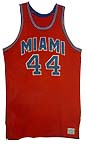
Floridians 1968-69
Home Uniform

Floridians 1969-70
Road Uniform

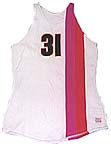
Floridians 1970-72
Home Uniform

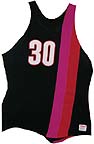
Floridians 1970-72
Road Uniform


FLORIDIANS YEAR-TO-YEAR RESULTS

1968-69 Season (known as Miami Floridians)

Record: 43-35, Second Place in Eastern Division
1969 Playoff Results:

Eastern Division Semifinals vs. Minnesota Pipers (36-42)
Floridians won series, 4-3

Eastern Division Finals vs. Indiana Pacers (44-34)
Pacers won series, 4-1


1969-70 Season (known as Miami Floridians)

Record: 23-61, Sixth Place in Eastern Division
Missed Playoffs


1970-71 Season (known as The Floridians)

Record: 37-47, Fourth Place in Eastern Division
1971 Playoff Results:

Eastern Division Semifinals vs. Kentucky Colonels (44-40)
Colonels won series, 4-2


1971-72 Season (known as The Floridians)

Record: 36-48, Fourth Place in Eastern Division
1972 Playoff Results:

Eastern Division Semifinals vs. Virginia Squires (45-39)
Squires won series, 4-0

Back to Main Page