|
Houston MavericksYears of existence: 1967-68 through 1968-69
|
Back to "Remember the ABA" Main Page
Did you see a Houston Mavericks game? Or, did you have a favorite Mavericks player? Contribute to this web page by
During the ABA's inaugural season (1967-68), only a few Houstonians bothered to come to the Sam Houston Coliseum to see their new pro team. Mavs players probably preferred playing on the road, since at least a few more people came out to watch them. On March 22, 1968, the Mavericks played a spirited game at New Orleans against the Bucs. Gary DeLaune, play-by-play man for the Mavs, described the game action to a sparse radio audience back in Houston.
|
During their first season, Houston rarely had crowds over 500 people. During their dismal second season, however, attendance was low to legendary proportions. The Mavericks often had crowds of less than 100 people, although such low figures were never officially reported to the press. Instead, the Mavericks front office padded their attendance figures so that the team seemed to have a "respectable" 500 fans each night. In December of 1968, UPI reported that 246 people saw the Mavericks play a game in Sam Houston Coliseum, which held nearly 7,000 people. The night before, 5,300 fans had crowded into a high school gym in Houston to see the University of Houston play Southern Mississippi.
As the 1968-69 season wound down (and the entire league knew that the team would be moving to North Carolina for the 1969-70 season--see below), Houston's front office became less sensitive about admitting the team's attendance problems. In February of 1969, the Mavericks' "official" average attendance, as reported to the press, was 378 people per game. During March and April of 1969, the official figure dipped to 333 fans per contest.
On April 2, 1969, the Mavericks played their last game in Houston. The opponent was New York, and the announced attendance was 89. The Mavericks gave all 89 fans watching the finale a huge treat -- they crushed the Nets 149-132. Both the Mavericks' scoring output (149 points) and attendance figure (89 people) set official team records.
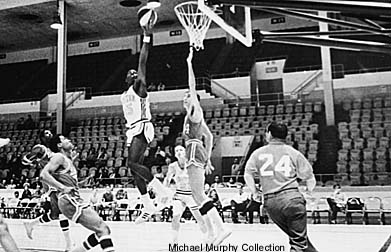 |
 The photo above is from a Houston Mavericks home game in February 1969. The Dallas Chaparrals were the visiting team. Aside from a few fans in the front row, the Sam Houston Coliseum is completely empty. According to the Houston front office, the team's average home attendance during this particular month was 378. Judging from this photo, this figure is grossly padded. The photo above is from a Houston Mavericks home game in February 1969. The Dallas Chaparrals were the visiting team. Aside from a few fans in the front row, the Sam Houston Coliseum is completely empty. According to the Houston front office, the team's average home attendance during this particular month was 378. Judging from this photo, this figure is grossly padded.
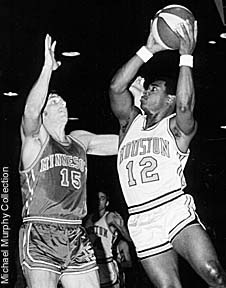
At right is Willie Somerset (#12), out of Duquesne. Somerset was probably the best Mavericks player. During the 1967-68 season, he averaged 21.7 points per game. During the 1968-69 season, he upped his output to 23.8 points per game under very trying conditions. In November 1968, the league took over operation of the franchise. Apparently, the league wanted the team to fail badly so the franchise could easily be moved to greener pastures (like North Carolina). Somerset was helping the Mavericks too much with his high scoring output. So in late January 1969, the league traded him to the New York Nets for Bob Verga (who, strangely enough, had played his college ball at Duke). (photos courtesy of Michael Murphy) |
One of the first-year standouts for Houston was forward Art Becker, who made the 1st ABA All-Star team. Willie Somerset was also an excellent player for the Mavericks, averaging 21.7 points per game in 1967-68. During the Mavericks' second season (1968-69), their respected coach Slater Martin quit one month into the campaign. This prompted Art Becker to actually coach the team for a week, until a new coach (Jim Weaver) was found. Also during the Mavericks' second season, owner T.C. Morrow informed the league office that he would not spend any more money on the team. To prevent the Mavericks from folding in the middle of the season, the league took over the franchise and ran the team, even to the point of making trades and releasing players to keep the payroll down. Fortunately for the ABA, North Carolina businessman Jim Gardner agreed to buy the Mavericks in early January of 1969 for a reported $650,000. Gardner wanted to move the Mavericks to Carolina (where they would eventually become the Carolina Cougars), but agreed to finish the season in Houston.
About the only interesting thing to happen to the Mavericks on the court during their lame-duck stretch run was an amazing free throw streak that occurred on January 17, 1969 in New York. The Mavericks set an all-time pro record when they hit all 36 of their free throws in their victory over the Nets. Two Houston players, Tony Jackson and Stew Johnson, were a combined 25 for 25 from the line. The Mavericks actually hit 43 free throws in a row, because they had hit their last seven in a double overtime victory over the Minnesota Pipers the night before. Don Carlos broke the incredible string when he missed Houston's first foul shot versus Kentucky on January 18.
 |
 |
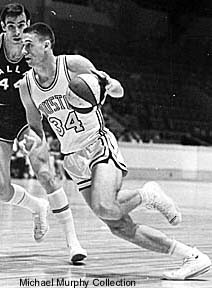 |
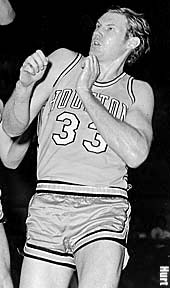
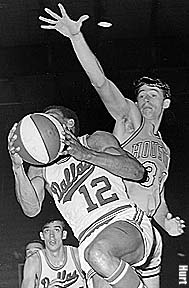
| The jackpot goes to you if you can recognize the Houston Mavericks players in these photos. At left is the immortal (and surprised) Dick Clark , who only played 32 games with the team in 1968-69. In the middle and at right is the somewhat more recognizable Art Becker, out of Arizona State. Becker averaged 18.8 points per game in Houston's first season, and 13.4 points per game in 1968-69. (photos courtesy of Jon Singer and Michael Murphy) | ||
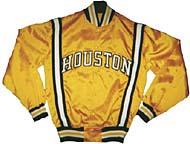 Mavericks 1968-69 Prototype Home Warmup |
1967-68 Season
Record: 29-49, Fourth Place in Western Division
1968 Playoff Results:1968 Western Division Semifinals vs. Dallas Chaparrals (46-32)
Chaparrals won series, 3-2
Record: 23-55, Sixth Place in Western Division
Missed Playoffs

 1967-68: Slater Martin
